
 STAMTEC IN 60 SECONDS:
STAMPING PRESS BLOG
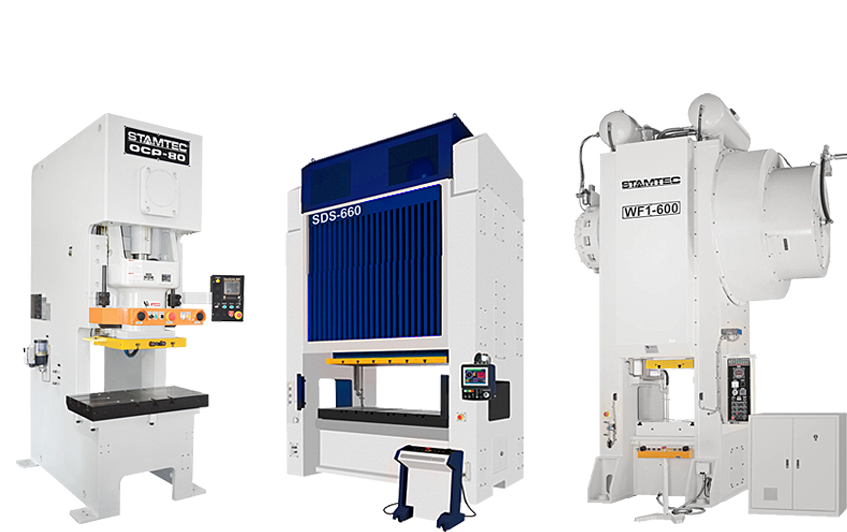
Hydraulic overload protection (HOLP) is a built-in safety system that stops a mechanical stamping press within milliseconds of a tonnage overload, before the excess force can reach the frame, crankshaft, or die. On a press without one, that same overload has nowhere to go but into the machine itself. Every Stamtec mechanical press, gap frame, and s...
A metal bracket, an appliance panel, and a car door seem an unlikely trio, but they have at least one thing in common: they're all products of a stamping press. What is a stamping press and how does it work? This machine applies controlled force to a sheet or coil of metal, pressing it against a shaped tool, called a die, to cut, bend, or form it i...
If you've ever needed to hit ultra-tight tolerances or form fine surface detail without adding more steps or cleanup, chances are you've heard of the coining process. But what is coining, exactly, and how is it different from other metal forming techniques? Coining is a cold working process that uses high tonnage and precision tooling to force meta...
If you've worked in manufacturing, chances are you've seen a stamping press in action. There's something mesmerizing about the precision, speed, and power these machines bring to the production floor. But whether you're working with a gap frame or a straight-side model, understanding all the components may feel a little overwhelming—it's like...
When comparing a servo press vs. a hydraulic press, it's crucial to consider these machines' pivotal role in shaping, forming, and assembling various products.
They're essential for a broad array of industries, including aerospace, electronics, automotive, and consumer goods. By applying force to materials like metal, presses enable manufacturers to create components with precision and efficiency.
Hydraulic presses and servo presses are two of the most prominent types. Each has unique mechanisms, advantages, and applications, making it suitable for different manufacturing needs.
The hydraulic press, known for its immense power and versatility, has been a staple in heavy-duty manufacturing processes for decades.
On the other hand, the servo press, with its advanced control systems and precision, is increasingly used for tasks that require high accuracy and repeatability.

Choosing the right type of press for your manufacturing needs is crucial to maximizing efficiency, precision, and reliability in your production line. While the debate over the mechanical press vs. hydraulic press has been extensive, the emergence of servo presses introduces a game-changing perspective. This comparison article will clarify the capabilities, limitations, distinctions, and applications of these traditional technologies and briefly touch on servo presses as a great alternative for many modern manufacturers, especially those in the metal stamping and automotive industries.

A mechanical press generates force by using a motor coupled with a mechanical flywheel. It's a fundamental tool in metal forming, renowned for its high-speed capabilities and dependability. The mechanical press is also an essential asset in high-volume manufacturing environments.
Your Stamtec press is humming along, working just as it should, when, suddenly, there’s a lube fault warning on the press controls, and production stops.
There’s no need to panic, but there are steps you can take to troubleshoot the issue and get your press back online.
Step 1: Very first thing to do is to check and make sure there’s enough grease in the grease cannister. If there’s not, add grease till it’s up to the proper level, making sure to use the external zerk fitting to do so. Do not try to take the plunger out to refill the cannister – this will only cause excessive air pockets and increase your problems. Cycle the pump and see if the lube fault is cleared, if not move to Step 2.

